
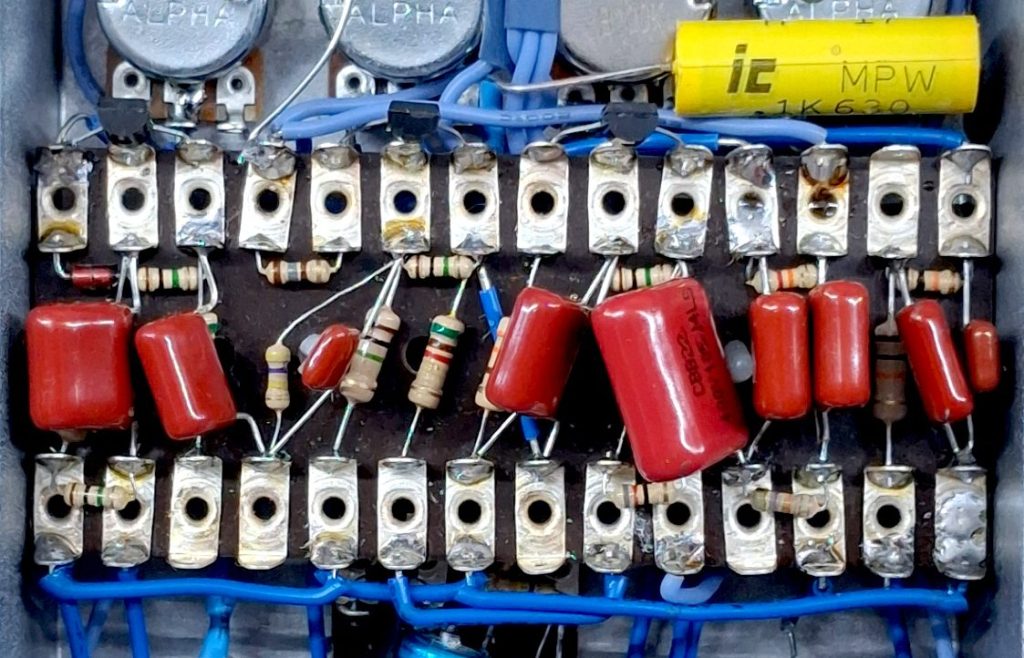
Recently I’ve completely changed the way I approach creating my circuits and that is using tagboards. But what is a tagboard?

Tagboard is nothing new: it’s the way old amps (and much of the electronics) were made before there were pcbs and it was used after point to point wiring, where each component is wired directly to the next one.
Tagboard is basically a board with tags aligned on two sides, in rows. You insert your components on these tags, that have three holes, and so you have, on one side of the board all your circuit and components.
This makes it simple to build the circuit and even simpler to modifiy it, plus it makes for a very particular visual, having almost every component vertically aligned.
Also, this kind of boards rely heavily on axial capacitors: a call for a hunt for vintage caps!
I made the switch to tagboard circuits for effect pedals because of a single british maker: Joe from Hello Sailor Effects who not only makes beautiful guitar stomp boxes using tagboards, but also has a wonderful youtube channel with step by step videos on which he builds his circuits, sharing a laugh and a lesson.

So, Joe is the reason why I revolutionized my guitar pedal circuit addiction, but I also think he epitomizes a niche on guitar building using tagboards and vintage components, becoming a reference point for everyone interested in this way of costruction.
I think he is THE ONE who set the “basic rules” of what fascinated me to completely change my construction method, his builds are a “manifesto” of the beaty of the tag, which I would summarize as this:

- use of tagboards, preferring the brown ones (I buy them here);
- old, vintage, n.o.s. “mojo” components, the bigger and cooler, the better;
- an honest approach on what we think as a cool look: yes, this is nerdy stuff, but we like raw, bulky circuits with cool components showing off;
- a clean approach on wiring, but nothing super-clean. More of a military-clean approach to wiring.
I’ve seen people building beautiful point to point circuits (one name for all is another british chap: Markus from Reeves Electro) and the results are stunning work of art, but with tagboard circuits I feel something resonating more with me: these layouts give you the feel and impression of having a strong, present and massive analog circuitry, like you finally have “something” in your box, even maybe something to show off to fellow guitar enthusiasts/nerds like us.

it makes sense to me that if I am building or recreating a vintage circuit aming for a vintage sound, to have vintage components (mine are from Tim in Ukraine) on a vintage construction method.
Plus, there is kind of closing to the circle of the history of effect pedals: the first widely successful stomp boxes were all made by british guys: think about the Range Master, the Treble Booster, the Tone Bender, the Fuzz Face, the Wah… they were all made in England and these new builders like Hello Sailor and Reeves Electro (just to name a few) carry the torch of this tradition into the 21st century.

Finally, is there also a sonic improvement on using tagboards or point to point instead of pcbs? Some say that having the components physically connected produce a stronger signal than the pcb traces, preserving signal integrity, others say it doesn’t have any improvement.
In my point of view there is a simple psychological effect (pun intended) to it: if you are happy knowing you are using a cool stomp box stuffed with cool/mojo components, you feel good and if you feel good, you may even play better!
…and when a stomp box makes you play better, its job is done!




 Antica Pedaleria Ballini
Lascia un commento